Karl Barth and Vatican II
Reading an interesting piece in Etudes Théologiques & Religieuses about Karl Barth's take on Vatican II. In the piece, "L'ombre de Karl Barth à Vatican II", Gilles Routhier of the Université Laval in Québec argues that Barth, unlike his Calvinist confreres - W. A. Visser 't Hooft and Lukas Vischer - was less interested in the significance of Vatican II for ecumenical relations than what it said about the renewal of the Catholic Church, and whether the churches within the World Council of Churches were not also being challenged to engage in a similar process of renewal. Though ill health prevented him from accepting an invitation from the Secretariat for Promoting Christian Unity to be present at the Council, he visited Rome after the event and shortly before his death. For Barth, the place given to the Scriptures at the centre of Vatican II represented a new concern with the Word of God, even though he questioned the Roman "and" ... the Scriptures "and" Tradition ... Barth, writes Rothier, frequently compared what he found in Vatican II and in the World Council of Churches. For example, he praised the strongly Christological address by Paul VI at the opening of the second session. "Solches hat man weder in Amsterdam, noch in Evanston, noch in New Delhi gehört," he wrote, referring to the first three assemblies of the WCC.


Cardinal Kasper sees "significant progress" in ecumenism
The former president of the Pontifical Council for Promoting Christian Unity, Cardinal Walter Kasper sees "significant progress" in ecumenism according to a report in the German Protestant news agency, the evangelischer Pressedient. In the foreword to a new book by German Lutheran Bishop Friedrich Weber, "Zeitansage - Texte zur ökumenischen Lage", Kasper notes developments such as the declaration by 11 churches in Germany in 2007 on the mutual recognition of Baptism.
Secularisation or the return of religion?
Konf: Säkularisierung oder Rückkehr des Religiösen? "
URL zur Zitation dieses Beitrageshttp://hsozkult.geschichte.hu-berlin.de/termine/id=14498
| Veranstalter: | Friedrich-Ebert-Stiftung Archiv für Sozialgeschichte, Bonn Bonn |
| Datum, Ort: | 16.09.2010-17.09.2010, Konferenzsaal II |
| Deadline: | 12.09.2010 |
Autoren-Workshop des Archivs für Sozialgeschichte:
Säkularisierung oder Rückkehr des Religiösen? Gesellschaft und Religion seit der Mitte des 20. Jahrhunderts
Traditionelle Formen von Religion, Religiosität und kirchlichen Bindungen haben in Europa nach 1945 an Bedeutung verloren. Dieses vielfach als Säkularisierung beschriebene Phänomen bildet den Ausgangspunkt für den Band 51 des Archivs für Sozialgeschichte. Vergleiche mit zeitgleichen, aber teils gegenläufigen Entwicklungen nicht zuletzt in den USA, Lateinamerika, Afrika und Asien sowie mit deren Rückwirkungen auf Europa sollen Aufschluss über die allgemein-kulturelle Bedingtheit von Religiosität geben und den Blick für deren jeweilige gesellschaftliche Relevanz schärfen.
Der in Europa zu beobachtende Prozess der Säkularisierung wird gewöhnlich mit der sozio-ökonomischen Modernisierung, Rationalisierung und funktionalen Ausdifferenzierung der betroffenen Gesellschaften erklärt. Tatsächlich ging der Einfluss des Christentums als der auf dem Kontinent vorherrschenden Religion seit der Mitte des 20. Jahrhunderts zurück, was besonders die christlichen Kirchen zu spüren bekamen. Die Bindekraft gewachsener Milieus schwand, während auf Individualismus bedachte Lebensstile vornehmlich in den westeuropäischen Staaten zur Distinktion und Profilierung dienten. Zudem boten neue soziale Bewegungen konkurrierende, als modern empfundene und häufig eher flüchtige Vergemeinschaftungsformen an, ohne allerdings tiefgehende Deutungsangebote für die „letzten Dinge“ zu unterbreiten. In Osteuropa erreichte die Säkularisierung, abgesehen von Sonderfällen wie Polen, unterdessen ein noch wesentlich größeres Ausmaß. Die ideologisch motivierte Anti-Kirchenpolitik der herrschenden Staatsparteien marginalisierte Religion im öffentlichen wie privaten Leben gezielt.
Allerdings ist das Konzept der Säkularisierung in den letzten Jahren zunehmend in die Kritik geraten. Es wurde sogar als Prokrustes-Bett für die Geschichte von Religion und Kirche nach dem Zweiten Weltkrieg bezeichnet, als untaugliche „Meistererzählung“, die mit ihrer auf Europa fixierten Perspektive zu monokausalen Erklärungsmustern neige. Daher sind die Belastbarkeit und Aussagekraft des Säkularisierungskonzepts eingehend zu prüfen, wobei die bereits erwähnten vergleichenden Studien einer eurozentristischen Herangehensweise entgegenwirken sollen. Womöglich lässt sich sogar von einer Rückkehr des Religiösen sprechen. Auf jeden Fall erhalten auf diese Weise alternative, auf kulturelle Unterschiede abhebende Interpretationen größere Aufmerksamkeit. So nahm in den USA die Einflussnahme des Evangelikalismus auf die Politik spätestens ab den 1970er Jahren erheblich zu, was den scheinbar offenkundigen Zusammenhang zwischen Modernität und fortschreitender Säkularisierung – nicht allein für außereuropäische Räume – nachhaltig in Frage stellt. Näher beleuchtet werden darüber hinaus, mit ihren Auswirkungen auf Europa, die Befreiungstheologie in Lateinamerika als dezidiert gesellschaftskritische Kraft, das Anwachsen des politischen Islams in Afrika sowie in Asien virulente Säkularismus- und Religionskonzepte.
Auch in Europa blieben Religion und kirchliche Bindungen wirkungsmächtige Faktoren. Angebracht ist somit keine Geschichte des Niedergangs, sondern der Anpassung und Transformation angesichts sich verändernder gesellschaftlicher Rahmenbedingungen. Wie gezeigt werden soll, entfalteten die von der Säkularisierung herausgeforderten christlichen Kirchen ein beachtliches Reform- und Erneuerungspotenzial. Gleichzeitig weiteten sich die Optionen für religiöse Aktivitäten jenseits dieses tradierten Ordnungsrahmens beträchtlich aus. Der Islam erhielt infolge der Arbeitsmigration immer mehr Anhänger, zudem gewannen Sekten und esoterischen Strömungen an Bedeutung. Von einer umfassenden Verweltlichung kann also nur schwerlich die Rede sein.
Donnerstag, 16. September 2010
11.00 Uhr
BEGRÜßUNG UND EINFÜHRUNG
Anja Kruke/Meik Woyke, Bonn
11.15 Uhr
Eröffnungsvortrag
DIE NEUKODIERUNG DES GLAUBENS. RELIGIÖSE AUF- UND UMBRÜCHE SEIT 1945
Benjamin Ziemann, Sheffield
THE PEOPLE OF NO RELIGION: THE RISE OF ATHEISM, AGNOSTICISM, FREETHINKING AND HUMANISM IN THE NORTH ATLANTIC WORLD SINCE 1960
Callum Brown, Dundee
DAS WECHSELVERHÄLTNIS VON MIGRATION UND RELIGION NACH 1945 – GRUNDPROBLEME UND TENDENZEN DER FORSCHUNG
Jochen Oltmer, Osnabrück
Moderation: Meik Woyke, Bonn
13.00 Uhr Mittagessen
14.00 Uhr
TRANSMISSION UND EVENTUELLE KIRCHE. BEOBACHTUNGEN ZU KIRCHEN-, KATHOLIKEN- UND WELTJUGENDTAGEN ZWISCHEN RELIGION UND GESELLSCHAFT
Harald Schroeter-Wittke, Paderborn
VON PILGERFAHRTEN ZU PROTESTMÄRSCHEN? ZUM WANDEL DES KATHOLISCHEN FRIEDENSENGAGEMENTS IN DEN USA UND DER BUNDESREPUBLIK DEUTSCHLAND, 1945–1990
Daniel Gerster, Florenz
DER STREIT UM DIE BERGPREDIGT. CHRISTEN IN DER FRIEDENSBEWEGUNG ZWISCHEN GLAUBE UND POLITIK (1977–1984)
Jan Ole Wiechmann, Marburg
Moderation: Anja Kruke, Bonn
15.45 Uhr
FROM CATHOLIC HEGEMONY TO PLURALISM. RELIGION AND PUBLIC LIFE IN ITALY FROM 1945
Franco Garelli, Turin
A SECULARISED CHURCH AND THE RELIGIOUS STATE – THE DEVELOPMENT BETWEEN STATE AND CHURCH IN POST-WAR NORWAY
Øivind Kopperud, Oslo
KIRCHLICHE PRÄSENZ IN DER FABRIK:
DAS EXPERIMENT DER FRANZÖSISCHEN ARBEITERPRIESTER
Veit Straßner, Mainz/Christian Bauer, Tübingen
Moderation: Dieter Dowe, Sankt Augustin
17.30 Uhr Kaffeepause
18.00 Uhr
DIE KATHOLISCHE WELLE DER STUNDE NULL. ZUR „KATHOLISCHEN AKTION“ IM NACHKRIEGSEUROPA (1945–1960). DEUTSCHLAND, ITALIEN UND FRANKREICH IM VERGLEICH
Klaus Große Kracht, Münster
EVANGELIZING LONDON, BERLIN, NEW YORK: EVANGELICAL TRANSNATIONALISM AFTER 1945
Uta Andrea Balbier, Washington
DIE PFINGSTBEWEGUNG ALS ALTERNATIVE ZUR SÄKULARISIERUNG? ZUR AKADEMISCHEN WAHRNEHMUNG EINER GLOBALEN RELIGIÖSEN BEWEGUNG DES 20. JAHRHUNDERTS
Jörg Haustein, Heidelberg
Moderation: Beatrix Bouvier, Bonn
20.00 Uhr
Gemeinsames Abendessen im Politischen Club der Friedrich-Ebert-Stiftung
Freitag, 17. September 2010
10.00 Uhr
„ZWISCHEN BEICHTSTUHL UND BARRIKADEN“. RELIGION ALS RESSOURCE DER INDIGENEN BEVÖLKERUNG GEGEN STAATLICHE MODERNISIERUNGSPROJEKTE IN MEXIKO 1950–1980
Heiko Kiser, Münster
DIE 32. GENERALKONGREGATION DER GESELLSCHAFT JESU 1974/75 ODER WIE DIE BEFREIUNGSTHEOLOGIE NACH ROM KAM
Antje Schnoor, Münster
DESMOND TUTU AND THE ANTI-APARTHEID MOVEMENT
Patrick Harries, Basel
Moderation: Patrik von zur Mühlen, Bonn
12.00 Uhr Mittagessen
13.00 Uhr
DIE KIRCHEN ALS SCHLÜSSEL ZUR POLITISCHEN MACHT? KATHOLIZISMUS, PROTESTANTISMUS UND SOZIALDEMOKRATIE IN DER ZWEITEN HÄLFTE DES 20. JAHRHUNDERTS
Rainer Hering, Schleswig/Hamburg
DIALEKTIK ODER KYBERNETIK? WISSENSCHAFTLICHE RESSOURCEN RELIGIÖSEN WISSENS IN DER BUNDESREPUBLIK DEUTSCHLAND (1965–1990)
Pascal Eitler, Berlin
ZWISCHEN SÄKULARISIERUNG UND AMBIVALENZ IM GESCHLECHTERKAMPF – ABTREIBUNGSRECHT UND RELIGIÖSE ARGUMENTATIONSMUSTER: SCHWEIZ, FRANKREICH, DEUTSCHLAND, ITALIEN, 1967–1981
Dagmar Herzog, New York
„RELIGION ALS INTEGRATIONSHINDERNIS“. DIE ENTWICKLUNG DES KIRCHLICHEN ISLAM-DISKURSES IN DER BUNDESREPUBLIK
Thomas Mittmann, Bochum
Moderation: Friedhelm Boll, Bonn
15.15 Uhr Kaffeepause
15.45 Uhr
KONFUZIANISMUS IN FESTLANDCHINA – SUCHE NACH ZUKUNFTSFÄHIGKEIT ZWISCHEN ZIVILGESELLSCHAFT UND ZIVILTHEOLOGIE
Monika Gänßbauer, Erlangen
ENTSÄKULARISIERUNG ALS GEGENENTWURF ZUM EUROPÄISCHEN MODELL? KONZEPTIONEN DER VERHÄLTNISBESTIMMUNG VON RELIGION UND POLITIK IN AFRIKA UND ASIEN
Frieder Ludwig, Hermannsburg
Moderation: Michael Schneider, Kalenborn
17.00 Abschlussdiskussion
Moderation: Meik Woyke, Bonn
18.00 Ende des Workshops
Zusätzliche Beiträge
SÄKULAR ODER RELIGIÖS? JÜDISCHES LEBEN IN DER BUNDESREPUBLIK DEUTSCHLAND
Michael Brenner, München
NEGOTIATING EMBODIED DIFFERENCE: VEILS, MINARETS, KIPPAS AND SUKKOT IN CONTEMPORARY EUROPE
Leora Auslander, Chicago
GLOBALISED EUROPE: THE TRANSFORMATION OF THE RELIGIOUS LANDSCAPE IN EUROPE
Patrick Pasture, Leuven
RELIGION, KIRCHE, STAAT UND OPPOSITION IN AUSGEWÄHLTEN LÄNDERN OSTEUROPAS
Detlef Pollack, Münster
SÄKULARISMUSKONZEPTE IM FRÜHEN POSTKOLONIALEN INDIEN, INDONESIEN UND SINGAPUR 1947-1970
Clemens Six, Bern
Bei Fragen zur barrierefreien Durchführung der Veranstaltung wenden Sie sich bitte vor dem Workshop an uns.
| Kontakt: | Meik Woyke + 49 (0)228 / 883 - 8068 |
| URL: | http:/ |
Richard Shaull and the globalization of the ecumenical movement
Maybe it is a cyclical generational thing, but suddenly there seem to be a whole series of reflections on the globalization of the ecumenical movement in the late 1960s and the early 1970s. In Karlsruhe, there is the project on the globalisation of the World Council of Churches, which is organizing a conference on the theme in March 2010. Now there is a new book by Angel D. Santiago-Vendrell, focusing on the contribution of the missiology of Richard Shaull to contextual theology and revolutionary transformation in Latin America. The 1966 World Conference on Church and Society in Geneva is remembered among other things for Shaull's contribution. Here's the blurb:
And here are the book details: Angel D. Santiago-Vendrell: Contextual Theology and Revolutionary Transformation in Latin America: The Missiology of M. Richard Shaull, Pickwick Publications, ISBN 978-1-60899-305-5.
U.S. audiences know Latin American liberation theologies largely through translations of Latin American Catholics from the 1970s and beyond. Most of the few known Protestant authors were students of Richard Shaull, whose critical thinking on social change, prophetic Christianity, and dialogue with Marxism and Christian use of Marxist analysis precedes the emergence of the formal schools of liberation theology by two decades. His own education at Princeton, and the education he provided in Brazil, charts the course of Protestant influences into this stream of theological reflection that became a global phenomenon in the latter decades of the twentieth century.
Also, Shaull's career roughly parallels the emergence of the World Council of Churches and the engagement of the Catholic Church—in Latin America and around the world—after the Second Vatican Council. He himself was engaged, and became the flash point, in some of the major conferences, movements, and institutions of the 1960s and beyond.
Santiago-Vendrell documents the entrance of the ecumenical movement in Brazil, among the most dramatic transformations in Catholic-Protestant relations around the globe, as well as Shaull's role in that development. Along the way he notes Shaull's prophetic and destabilizing role in the worldwide student movement in the 60s and 70s, charting decisions that mark the ecumenical movement. Shaull's contributions are important for an understanding of the ethical debates in the worldwide, ecumenical Protestant and Orthodox communities.
Santiago-Vendrell examines primary, secondary, and historical documents that shine a light on Shaull's transformation into a contextual theologian of the poor. He offers a definitive view of this North American Protestant missionary who wrote extensively on Latin American liberation theology, the base Christian communities, and how conversion to solidarity with the poor offers transforming possibilities for the mainline churches' theological identity and practical faith.
And here are the book details: Angel D. Santiago-Vendrell: Contextual Theology and Revolutionary Transformation in Latin America: The Missiology of M. Richard Shaull, Pickwick Publications, ISBN 978-1-60899-305-5.
Secular islam?
Which 'operating system' do we need for the ecumenical movement?

It might seem superfluous on a blog called 'Open Source Ecumenism' for such a question even to be posed: surely the answer is clear: the Mac/PC dichotomy is to be transcended through a common appeal to Linux, an open source operating system based on a common core to which people in different contexts can contribute or customize for their local situation. Yet, as John Gibaut, the WCC's director of Faith and Order, pointed out in a recent contribution to a meeting of Churches Together in Britain and Ireland, churches currently function with a range of operating systems when it comes to how they understand themselves as churches:
To use an imperfect analogy from the world of information technology, ecclesiology is like a church’s operating system. If we are using incompatible operating systems, it will not be possible to share texts, programs, or even to communicate with one another. “Ecclesiology” is such a specialized term, that I tend not to use it outside of an academic or Faith and Order context, because too many people, even those engaged in the ecumenical movement, are frightened off by the very word! And yet, like an operating system, which is as equally frightening to some of us, it is requisite if we are serious about the visible unity of the Church in one faith and in one eucharistic fellowship.The Christian Internet conference has on its agenda a range of issues. These include, "Hyperlinks subvert hierarchies: Institutional changes needed to communicate in social networks", "Do-it-Yourself or join existing platforms?", "The Voice of the People versus the Voice of an Institution".
But are these issues simply questions about how the church relates to information technology? Maybe they also raise issues about the future "operating system" for the nature and mission of the church itself.
'Losing a voice' - remembering Marlin VanElderen
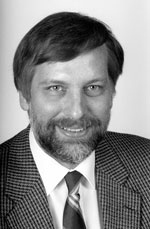 Today marks the 10th anniversary of the unexpected, untimely and tragic death at the age of 54 of Marlin VanElderen, officially the executive editor of World Council of Churches publications, but in reality the force tranquille of the WCC, sought out for his careful advice and his ecumenical memory, the chief drafter of the WCC's Common Understanding and Vision document, and known for his passion - albeit in a rather understated, Reformed, sort of way - for communicating not only the WCC, but the ecumenical movement.
It was Whit Monday - Pentecost was late in 2000 - and I was spending the day off by sitting under a glorious sun on the terrace of the WCC restaurant correcting proofs for the ENI Bulletin. I smiled and waved to Jan Kok, head of publications, as he walked through the garden to the door at the back of the building. Jan, the former WCC communications director, was already living with the cancer that would lead to his own early death at the beginning of 2002. He walked over to where I was sitting; he could get only two words out. "Marlin's dead." It seemed like an age before I took in that Jan was saying that his colleague and best friend at the WCC had died.
Pentecost - the feast of communication
Today I offered a meditation in the Ecumenical Centre to mark Pentecost as the great festival of communication. Here's an extract:
God's Spirit breaks down the barriers between nations, the barriers of culture, and the barriers of language. Being drawn together, being one, does not mean being identical. It means transcending the barriers that separate us, holding together our diversity in the power of the "breath of God's voice". This is a pronounced and profound experience of communication. And it is through this great "communicative act" that the disciples are able to communicate "God's deeds of power".The full text is here.
Still, if Pentecost is a profoundly "communicative" experience, it is also a profoundly "ecumenical" experience. At Pentecost in Jerusalem, representatives are gathered from "every nation under heaven", in other words, from the whole inhabited world, or, in Greek, from the oikoumene. It is at Pentecost that God's Spirit descends upon the oikoumene, gathered at this great ecumenical assembly in Jerusalem. So, Pentecost as the foundational event of the church is both communicative and ecumenical. Through God's embracing and inclusive Spirit we can comprehend the oikoumene in all its fullness, one in which that which was scattered is gathered together in a unity that transcends the economic and political divisions of the world. In our spirit-filled ecumenical existence, communication is at the very heart. It is through communication that we can become one - not despite our diversity, but in our diversity; not as an end in itself, but to speak about God's deeds of power.
Paradigm lost?
I first came across Thomas Kuhn's theory of the "Structure of Scientific Revolutions" in my first week at university, presented as a tool used by some economists to explain why economic theories change over time:
Raiser drew up his sketch of a new paradigm for the ecumenical movement shortly before the series of events at the end of the 1980s that marked, in one sense, the end of the post-war world of which the WCC was part. Konrad Raiser's sketch of an emerging paradigm was aimed at doing justice to an ecumenism of diversity. Yet both the old and the new paradigms identified by Raiser had one thing in common: both are an attempt to explicate the significance of the ecumenical movement through a comprehensive meta-narrative. Yet one challenge identified as facing the WCC and the ecumenical movement since 1989 has been precisely the lack of a such a paradigm, recognised and accepted by all participants. As Minna Hietamäki noted in her presentation to the Faith and Order plenary commission in 2009:
Broadly, this concept draws attention to the tendency for groups of intellectuals to become totally absorbed in the logical puzzles of a particular theory. When outside change occurs, then the intellectuals have to be wrenched reluctantly back from metaphysical speculation to the problems of the real world and a new theoretical formulation, or paradigm, may become dominant. For instance, the intricacies of a theory suitable for an economy based on steam technology with small-scale firms run by owner-managers will not be suitable for large-scale, multinational, joint-stock corporations operating in the nuclear age. (Cole et al, Why Economists Disagree, pp.11-12)This is what is called a "paradigm shift," though Kuhn himself, was reluctant to apply his theory to social science. A decade or so later, Konrad Raiser applied the theory of paradigm shift to the ecumenical movement in his book, Ecumenism in Transition. In his book, Raiser contended that the old paradigm of the ecumenical movement is being superceded by a new one. The old paradigm Raiser characterises as "Christocentric universalism", marked by "the Christocentric orientation, concentration on the church, a universal perspective, and history as the central category of thought" (p.41). Against this background, Raiser identifies three main emphases for a new paradigm: a Trinitarian understanding of the divine reality and of the relationship between God, the world and humankind; "life", understood as a web of reciprocal relationships, as a central point of reference (instead of history); and an understanding of the one church in each place and in all places a fellowship in the sense of a community of those who are different from one another (p.78). Central to this new paradigm is an understanding of the oikoumene as a household, an "oikos", the "one household of life created and preserved by God, that extends beyond the world of humankind, of the one human race, to creation as a whole" (pp.87-8). Elements of this new paradigm could be observed in the 1990s in the WCC in such areas as the "Theology of Life" programme, the process to develop a Common Understanding and Vision for the WCC, and in Raiser's WCC general secretary report to the 1998 Harare assembly.
Raiser drew up his sketch of a new paradigm for the ecumenical movement shortly before the series of events at the end of the 1980s that marked, in one sense, the end of the post-war world of which the WCC was part. Konrad Raiser's sketch of an emerging paradigm was aimed at doing justice to an ecumenism of diversity. Yet both the old and the new paradigms identified by Raiser had one thing in common: both are an attempt to explicate the significance of the ecumenical movement through a comprehensive meta-narrative. Yet one challenge identified as facing the WCC and the ecumenical movement since 1989 has been precisely the lack of a such a paradigm, recognised and accepted by all participants. As Minna Hietamäki noted in her presentation to the Faith and Order plenary commission in 2009:
The unity and diversity of the Church cannot be separated from the concrete contexts and the concrete web of relations where the relations exist. As in the koinonia-relations described earlier, also in concrete life situations we are faced with relations which can be described by mutual dependency, where logical priority or priority-in-status does not destroy the mutual indwelling and which are not interchangeable. This leads me to the practical challenge that follows from describing the Church as essentially diverse in its unity. If we are not to fall into an unspecific pluralism, we need to retain the possibility to say and show what is and what is not properly Christian. But how is it possible to identify the “true Christian community” when the Church’s oneness can essentially be described only by diversity that reaches from the very being of God to the variety of cultural and linguistic contexts and when the essence of the community lies in noninterchangeable relations?
Looking to unity with Benedict XVI

Today there are many complaints that ecumenism has come to a standstill, mutual reproaches, but I think, first of all we should be thankful that there is as much unity as there is. It is a wonderful thing that today on Laetare Sunday we can pray together, sing the same hymns with one another,hear the same Word of God with one another, interpret it and attempt to understand it together, that we look to the same Christ whom we see and to whom we want to be obedient, and that we witness to the fact that he is the One who has called us and to who we profoundly belong. I think we should not being showing the world all kinds of quarrels and disputes but joy and gratitude that this has been given to us by the Lord and that there is genuine unity, that may become increasingly deeper and increasingly a witness for the word of Christ, for the path of Christ in this world. of course we must not be satisfied with this, even if we are filled with gratitude for this fellowship. that is nevertheless in essential things, in the celebration of the Holy Eucharist, are not able to drink the same cup, nor stand at the same altar, must fill us with sadness, that we are guilty of obscuring the witness; it must make us inwardly restless, to set us on the path to greater unity in the knowledge that ultimately can be given only by him, for a unity that we ourselves would negotiate, would be made by humans and as brittle as everything that is made by human hands. We give ourselves to him, seek to know and to love him him more and more, and leave to him that he will fully lead us to unity, for which we in the hour pray to him in all urgency.(Photo from evangelisch.de)
It's time for 'civil disobedience' to advance ecumenism

Speaking at the book launch, Brosseder said that between Protestants and Catholics there are no differences in the basic understanding of the church, while the practice of faith is necessarily ecumenical, as both church traditions believe in the same God. However, ecumenical progress is still hindered by church leaders. Anyway this is what the book blurb say (apologies for the scratch translation):
The fundamental issues and insights regarding the understanding of church and ministry are discussed in an ecumenical perspective, making clear where there is an existing consensus, studying more contentious issues and examining possible solutions.
It is shown that there is no difference in the insight that there is the necessity of a ministry of Word and Sacrament, including the ministry of episkope (supervision, church leadership)but that there are differences in the way in which this ministry is embodied. But in making a distinction between content and form this does not have and should not have a church-dividing character. The book sets out an analysis of the ecclesial communion that already exists and the models that have been drawn up for future ecclesial communion (Fries-Rahner-plan, conciliar fellowship, unity in reconciled diversity). This leads to the last chapter, under the heading "Unity in that which is necessary, freedom in controversial issues, love in everything", to the concluding considerations on the existing consensus about basic doctrinal and ethical issues, an analysis of the controversies that remain on these issues and their importance, and concrete proposals as to how ecclesial communion towards a mutual recognition as churches can already be practised and put into effect.
The globalisation of the World Council of Churches

An international conference from 4 to 6 March 2011 at the Ecumenical Institute in Bossey organized under the auspices of the research project, “On the Road to a Global Christendom: European Protestant Ecumenism and the ‘Discovery’ of the ‘Third World’”, is to examine this these changes from a global historical and ecumenical perspective. It will be of particular importance to analyze the historical, sociopolitical and theological developments in the 1960s and 1970s which contributed to this change (decolonization, liberation movements, revolutions, human rights, the Second Vatican Council, the rise of contextual theologies and so on.).
A call for papers has been addressed to researchers working on areas concerning the WCC since the 1960s, from a historical or theological perspective, or those researching the “getting global” of churches during the 1960s and 1970s from other angles.More details here (scroll down for English).
Looking to transcend capitalism and communism in Seoul
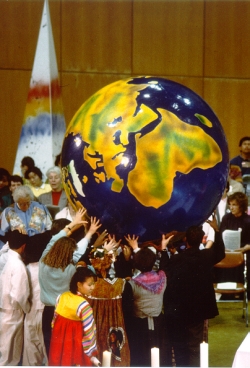 Today - 5 March 2010 - marks the 20th anniversary of the opening of the World Convocation on Justice, Peace and the Integrity of Creation (JPIC) . Planned as the culmination of the JPIC process - better known in the then two German states as the "Conciliar Process" - delegates from all parts of the world converged for a week's deliberations in the South Korean capital of Seoul. It was intended to express "the urgent call for authoritative witness by the churches" in the face of injustice, hunger and poverty; war and violence; and destruction of the environment, stemming from an initative at the WCC's 1983 assembly in Vancouver, which, in large part due to efforts of the delegates from the German Democratic Republic, called on the WCC "to engage member churches in a conciliar process of mutual commitment to justice, peace and the integrity of creation".
Here, a key role had been played by the GDR theologian Heino Falcke, both in the run-up to the Vancouver assembly and in subsequent elaboration of the Conciliar Process in the GDR and at the global level.
In the GDR, the high point of this conciliar process was an Ecumenical Assembly of Churches and Christians which met in three sessions in 1988 and 1989, and which, not least because of the involvement of peace, environmental and human rights groups, made unprecedented demands for the reform of the GDR and influenced the citizens' movements and political parties formed at the time of the peaceful revolution of autumn 1989. According to Heino Falcke:
The ecumenical assembly raised the floodgates enough to release the log-jam of change. It gave an ecumenical inspiration to the dynamic for change, which also in a way gave it legitimacy; and above all, it gave it a direction that was set by the gospel.An ecumenical gathering was held in 1988 in the Federal Republic of Germany, and in May 1989, the first European Ecumenical Assembly, "Peace with Justice", took place in the Swiss city of Basel. By the time the Convocation met in Seoul, however, the world had experienced a change of momentous dimensions. The epochal shift can be seen not least in the chronology of the GDR itself. The Basel assembly took place just after the widespread rigging of already undemocratic municipal elections in the GDR that was one of the triggers for the "peaceful revolution" of autumn 1989. The world convocation the following year took place immediately before the elections of March 1990 in the GDR that led to the first freely-elected Volkskammer, the GDR parliament. Many of those - like Falcke - involved in the events that led to the "peaceful revolution" considered that they had taken part in a movement for liberation and a new more just, peaceful and sustainable world order.
Yet, for many of those in Seoul from the Global South, the events in Europe at the end of the 1980s were being regarded with suspicion. Certainly, in his address to the Seoul convocation, Frank Chikane, then general secretary of the South African Council of Churches - from a country where the release of Nelson Mandela and the unbanning of the African National Congress was also experiencing an epochal shift - described the changes in Europe as an opportunity to leave behind old models based on capitalism and communism and to replace them with new models "aimed at moving towards the Kingdom of God". However, he warned also that if the "First and Second World come together on the basis of the old system ... the remaining two-thirds of the world will be in trouble".
At the same time, the voices of Christians from the two German states (and especially the GDR), who had in many ways provided the motor for the conciliar process, were muted in Seoul. The specific conditions within the GDR which had given such force to the conciliar process disappeared with the autumn revolution. The conciliar process, whose origins lay in an initiative at a time of heightened East-West tension, was being overshadowed by the process of German unification. By the time the world convocation took place in Seoul, immediately before the GDR's free elections of March 1990, the collapse of state socialism in Eastern Europe and the accelerating process towards German unification had fundamentally shifted the terms of the debate.
In a recent paper, Falcke noted how East Germans themselves had little time after the opening of the Berlin wall on 9 November 1989 to reflect on the significance of the epoch-changing events. Instead, they were fully consumed by the "breathtaking processes" in their own country that led to the unification of Germany, 11 months later, in October 1990.
Falcke said that travelling to Seoul for the World Convocation had allowed him to gain a different perspective:
While I was there. I was often greeted with the joyful words, "The wall has been broken down!", but was made to feel very clear just how this process was seen from the perspective of other problems in the world and especially about the hopes and fears in Central America and Asia about the revolutions in Eastern Europe and the end of the Cold War.[The photo shows the closing worship at the Seoul convocation. Souce: http://www.wcc-coe.org/wcc/what/jpc/hist-e.html]
:: Crosspost from Holy Disorder.
'Unity is strength, but diversity is wealth'

I was reminded of all this when reading a recent blog post by Dan Smith on the "long term view" for the new EU high representative for foreign affairs, Catherine Ashton.
Poetic ecumenism

War ... where theology meets politics
Dan Smith, who in the 1980s was a prominent activist in the movement for nuclear disarmament, has just published a blog post which analyses Barack Obama's intellectual debt to the just war theory, in the U.S. president's acceptance speech for the Nobel Peace Prize.Smith notes
The Just War tradition is prevalent to a degree many people do not notice and it is perhaps surprisingly durable. Any time you think of a specific action in a war as unjustified, any time you name something as an atrocity, or criticise forces for causing civilian casualties, or for treating prisoners inhumanely, you are – knowingly or not - drawing on the Just War tradition. It is, therefore, one of the intellectual and moral currents that shape the Red Cross/Red Crescent movement and humanitarianism in general as well as the ideas underlying International Humanitarian Law, which used to be known as the Laws of War. Likewise if you criticise war or an act of war as aggressive, or lacking in proper authority, or as aimed at securing power and wealth rather than defending a territory and its people, you are – knowingly or not - drawing on the Just War tradition. It is, therefore, one of the intellectual and moral currents that shaped the United Nations and the legal idea that a war of self-defence is justified but a war of aggression is a crime against humanity. In fact, Just War so imbues our thinking on what is right and wrong in war that much of what it’s about has the status of commonsense.And while the Just War tradition as such is very much a Christian tradition, similar distinctions have long been influential in Islam.
Danish church decides to join Porvoo ... in time for the Archbishop of Canterbury
Alongside the events in Copenhagen for the climate change summit, a brief press release on Friday (11 December) in Danish announced that the Evangelical Lutheran Church of Denmark has decided to join the Porvoo Communion of Anglican churches in the British Isles and Ireland, and Nordic and Baltic Lutheran churches.
Benedict XVI and Liberation Theology
The Zenit news agency today carried a report that Benedict XVI had told a group of Brazilian bishops on 5 December that Brazil needed to get over the divisions left by Marxist-inspired liberation theology (the Vatican text of the Pope's statement is here in Portuguese).
From World Mission to Interreligious Witness ...
The Irish School of Ecumenics has announced a 2010 conference on "From World Mission to Interreligious Witness: Visioning Ecumenics in the 21st Century":
The centenary of the ecumenical 1910 World Mission Conference in Edinburgh is an opportunity to engage, critically, with the achievements and failures of Ecumenics as that can be interpreted through the changes of vision and action manifest in the ecumenical movement. From the vantage point of the new century, one of the most important elements of revisioning relates to the character and concept of ecumenical Christian witness across cultures and faiths. The diversity of cultures and faiths was, of course, already evident in 1910 and provided the context in which ‘world mission’ was envisaged. However, political, philosophical and theological developments of the 20th century have recalibrated the significance of that diversity and have raised radical new questions for Christianity in its many manifestations:
The centenary of the ecumenical 1910 World Mission Conference in Edinburgh is an opportunity to engage, critically, with the achievements and failures of Ecumenics as that can be interpreted through the changes of vision and action manifest in the ecumenical movement. From the vantage point of the new century, one of the most important elements of revisioning relates to the character and concept of ecumenical Christian witness across cultures and faiths. The diversity of cultures and faiths was, of course, already evident in 1910 and provided the context in which ‘world mission’ was envisaged. However, political, philosophical and theological developments of the 20th century have recalibrated the significance of that diversity and have raised radical new questions for Christianity in its many manifestations:
Rastafari Theology

Subscribe to:
Posts (Atom)

 Posts
Posts

